
How to Spot Signs Your Semi Truck Needs Engine Diagnostics
Last Updated: November 14, 2026
Quick Summary
Signs your semi truck needs engine diagnostics include a solid, flashing, or red check engine light, loss of power and derate, excessive exhaust smoke, dropping fuel efficiency, rough idle, engine knock, and low oil pressure. A flashing light or red stop light means stop, while a solid amber light means scan it soon.
A flashing check engine light signals an active misfire or serious fault, so reduce load and stop.
A derate that clears after a restart is not fixed and is waiting to strand you.
Black smoke points to too much fuel or restricted air; blue smoke means burning oil.
A basic scanner cannot run bidirectional tests, force DPF regeneration, or calibrate replacement sensors.
Schedule service by engine hours, not just odometer, because long idle hours wear components without adding miles.
Warning light on your rig right now?
Big Rig Repair offers 24/7 diagnostics and roadside help to get your truck back on the road.
Table of Contents
Semi Truck Check Engine Light Diagnosis: What the Warning Indicators Mean
Diesel Truck Loss of Power and Derate: When Your Engine Pulls Back
Exhaust Smoke, Fuel Efficiency, and Other Physical Warning Signs
Semi Truck Engine Fault Codes: What Your Scanner Is Telling You
Heavy-Duty Truck Diagnostic Scan: DIY vs. Professional Threshold
Preventative Maintenance Schedules That Reduce Diagnostic Frequency
Book Engine Diagnostics Before a Warning Becomes a Breakdown
Why Early Engine Diagnostics Save You Thousands in Downtime
A semi truck that quits on the shoulder costs far more than the repair bill. It costs the load, the delivery window, and the driver's day. That is why engine diagnostics matter long before a warning light turns red.
A small fault that gets ignored can turn into a derate, then a tow. Catching it early can cost less. For a concrete fleet plan, see our guide to minimizing commercial truck downtime.
Engine diagnostics is the process of reading a heavy-duty truck's fault codes and live sensor data to find the real cause of a problem. It separates a cheap fix from an expensive one.
Below, we walk through the warning signs in order of severity, so you know when to keep driving and when to pull over.
FMCSA roadside inspection and vehicle maintenance resources
Semi Truck Check Engine Light Diagnosis: What the Warning Indicators Mean
A check engine light on a semi is a request for a semi truck check engine light diagnosis, not a death sentence. It means the engine computer stored a fault code. The severity depends on the code and the color of the light.
Here is how to read the common indicators:
Solid amber check engine light: a stored fault. Keep driving, but scan it soon.
Flashing check engine light: an active misfire or serious fault. Reduce load and stop.
Red stop engine light: shut down as soon as it is safe. Damage is likely.
Amber warning triangle: a system fault, often emissions or aftertreatment.

The mistake we see most is treating a flashing light like a solid one. A flashing light means stop. Ignoring it can turn a sensor repair into a rebuild.
Diesel Truck Loss of Power and Derate: When Your Engine Pulls Back
A diesel truck loss of power and derate is the engine protecting itself. When the computer senses a fault it cannot correct, it limits power and speed to prevent damage. You feel it as sluggish throttle response and a truck that will not pull a hill.
Derate comes in stages. Some allow highway speeds. Others cap you at a crawl. The trigger is usually a fault code tied to fuel, air, or emissions.
Watch for these signs under load:
Power fades on grades that used to be easy
The truck caps speed without warning
Throttle response feels delayed or flat
The derate clears after a restart, then returns
A derate that resets after a restart is not fixed. It is waiting to strand you. Scan it before the next long haul.
Exhaust Smoke, Fuel Efficiency, and Other Physical Warning Signs
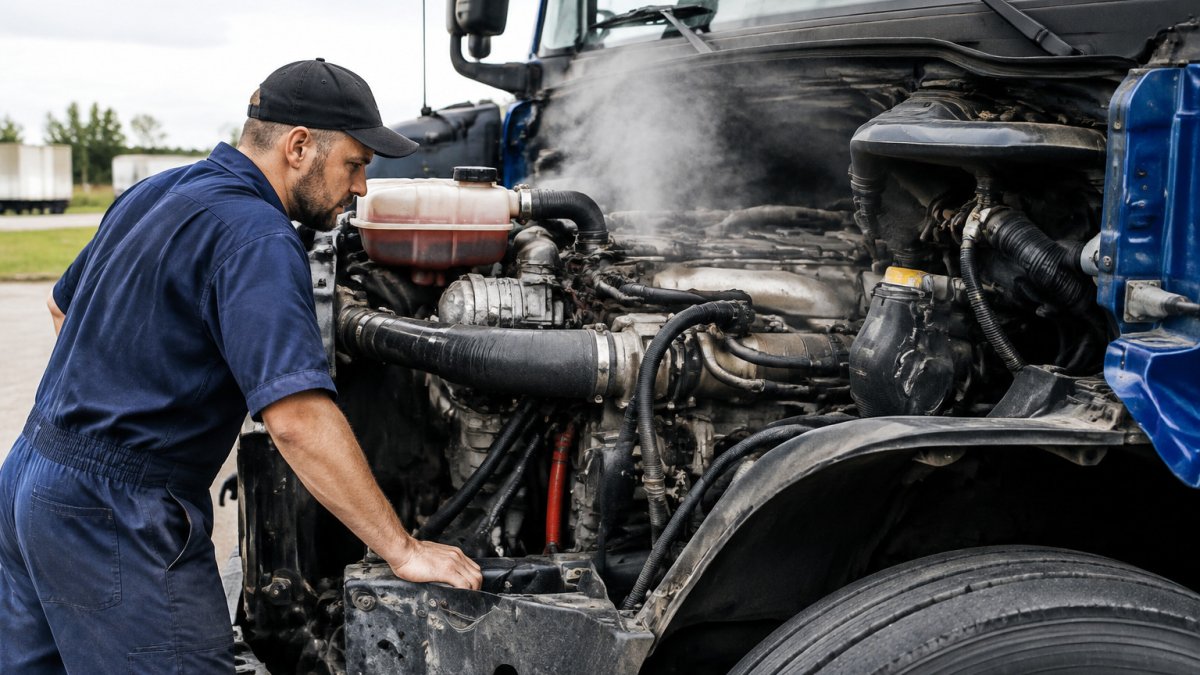
Excessive exhaust smoke and a drop in fuel efficiency are physical signs your semi truck needs engine diagnostics. The engine is telling you something before any light comes on.
Match the smoke color to the likely cause:
Black smoke: too much fuel or restricted air. Check the air filter and fuel injectors.
Blue smoke: burning oil. Often worn rings or a failing turbocharger.
White smoke: unburned fuel or coolant. Can point to injectors or a head gasket.
Other physical clues include a rough idle, engine knock, low oil pressure, and coolant levels that keep dropping. Poor fuel efficiency often shows up first. A truck that suddenly drinks more diesel is working harder than it should.
Semi Truck Engine Fault Codes: What Your Scanner Is Telling You
Semi truck engine fault codes are the computer's notes on what went wrong. A diagnostic scanner reads them through the vehicle's diagnostic connector. The code is a starting point, not the answer.
Heavy-duty engines commonly use fault code structures defined by SAE J1587 and J1939 standards. A J1939 diagnostic trouble code is a four-part number: the source address (which ECU reported it), the suspect parameter number (what is being measured), the failure mode indicator (how it failed, high, low, intermittent, out of range), and an occurrence count. That structure is why two trucks with the "same" code can need different repairs: the failure mode and the circuit that set it differ.
Codes fall into rough groups:
Active codes: faults happening right now. The ECM is acting on them, often by derating.
Stored (inactive) codes: faults that happened and cleared. They may return under the same load or temperature conditions.
Pending codes: faults the computer is still confirming across drive cycles.
History codes: logged events kept for technician review, sometimes for hundreds of engine hours.
A common mistake is replacing parts based on the code alone. A code names a system, not a failed component. For example, a code for low fuel rail pressure can be caused by a clogged fuel filter, a failing lift pump, a stuck pressure relief valve, an injector returning too much fuel, or a chafed harness. Replacing the sensor because the code mentions the sensor is how a $200 fix becomes a $2,000 parts cannon.
Reading live data alongside the code is what finds the real fault. A technician compares commanded versus actual values, rail pressure, turbo boost, EGR position, DPF differential pressure, while the engine is under load. A code that only sets at 1,400°F exhaust temperature or above 25 psi boost tells a very different story than one that sets at idle.
Clearing a code without recording it first can erase freeze-frame data and occurrence counts that help identify the root cause.
For a step-by-step look at how mobile diagnostics work in the field, see our guide to mobile diesel engine diagnostics.
Heavy-Duty Truck Diagnostic Scan: DIY vs. Professional Threshold
A heavy-duty truck diagnostic scan is worth doing yourself only up to a point. Basic code reading is fine for a driver with a scanner. Deep diagnosis is not. The gap between the two is wider than most drivers realize, and it is where the money is won or lost.
Here is where we draw the line:
Situation | DIY is fine | Call a professional |
Reading a stored or history code | Yes | No |
Clearing a code you have already recorded | Sometimes | Often |
Flashing or red stop light | No | Yes |
Derate that keeps returning | No | Yes |
Emissions, DEF, or DPF fault | No | Yes |
Live sensor data analysis under load | Rarely | Yes |
Bidirectional tests (injector cutout, turbo actuator) | No | Yes |
Aftertreatment regeneration forced by scan tool | No | Yes |
What a basic scanner can do. A sub-$300 handheld or a Bluetooth dongle paired to a phone app will read and clear generic powertrain codes on the J1939 bus.
What it cannot do. A basic scanner cannot run bidirectional tests, cannot command an injector cutout to isolate a misfiring cylinder, cannot force a DPF regeneration, cannot perform a cylinder balance test, and cannot read proprietary manufacturer parameters the way a factory tool (Cummins INSITE, Detroit DiagnosticLink, PACCAR ESA, Volvo Tech Tool) can.
The emissions trap. Aftertreatment faults are a common reason a truck derates. A DIY code clear on a DPF or SCR fault does not fix the underlying issue, it just resets the clock. Tampering with or defeating emissions systems can carry penalties under federal and state rules (the EPA). Emissions faults are the clearest case for professional intervention.
The cost-benefit math. Pricing depends on the diagnostic work required. A misdiagnosed repair, replacing a turbo because a boost code pointed there when the real fault was a boost sensor, can cost far more than the scan itself. Contact Big Rig Repair for a quote on your specific truck.
The threshold in one sentence. If the code is stored, the light is amber, and the truck drives normally, a DIY read-and-record is reasonable. If the light is flashing or red, the derate returns after a restart, the fault is emissions-related, or you are about to spend money on parts, stop and get a professional scan.
When a professional scan is the right call, our team provides expert engine diagnostics and repair services to find the fault and fix it right.
Preventative Maintenance Schedules That Reduce Diagnostic Frequency
A steady preventative maintenance schedule cuts how often you need diagnostics at all. Clean fuel, fresh oil, and healthy filters keep fault codes away.
Build your schedule around these checkpoints:
Oil and filter changes on the manufacturer's interval
Fuel filter swaps before they clog and starve the injectors
Coolant and DEF checks at every service
Air filter inspection on a set mileage
Battery and sensor checks during routine service
Idle time matters more than most fleets realize. Long idle hours wear components without adding miles, so schedule service by engine hours, not just odometer. For a full plan, read our guide to preventive maintenance for commercial fleets.
Book Engine Diagnostics Before a Warning Becomes a Breakdown
Many of these signs are cheaper to address early. A flashing light, a returning derate, or a puff of blue smoke is your engine asking for attention.
Big Rig Repair offers 24/7 big rig repair and road service with certified technicians and advanced diagnostics. Big Rig Repair emphasizes transparent communication and pricing. Contact us for current pricing.
Do not wait for a warning to become a breakdown. Contact our team to schedule diagnostics or get roadside help.
A truck that is down cannot earn. If a warning light or a derate has you parked, let our certified technicians scan it, explain the fault, and get you back on the road fast. Get started with Big Rig Repair and reduce your breakdown risks today.
Frequently Asked Questions
Can I keep driving my semi truck with the check engine light on?
A steady check engine light means the engine computer has logged a fault code, and you can often continue to the next safe stop while monitoring for changes. A flashing light is different: it signals an active misfire that can damage the catalytic converter and internal components within minutes. If the light flashes, pull over and call for roadside assistance. If it stays solid but you also notice loss of power, derate, or unusual smoke, treat it as a stop-now condition rather than a wait-and-see.
What causes a diesel truck to lose power and enter derate?
Derate is the engine computer protecting itself. Common triggers include low oil pressure, coolant temperature out of range, a failing sensor, clogged fuel injectors, turbocharger faults, or a DEF system malfunction. The truck limits torque and speed to prevent mechanical failure. A heavy-duty truck diagnostic scan pulls the specific fault codes behind the derate, which is the only reliable way to know whether you are looking at a sensor replacement or a major repair. Driving through a derate can turn a small fix into an engine rebuild.
What does black, blue, or white smoke from a diesel truck mean?
Black smoke points to over-fueling or restricted air flow, often from clogged injectors or a dirty air filter. Blue smoke usually means oil is burning, which can indicate worn rings or turbocharger seals. White smoke at operating temperature can signal coolant entering the combustion chamber or incomplete fuel burn. Any of these, especially combined with a check engine light or poor fuel efficiency, warrants diagnostics before the issue spreads.
How do technicians diagnose a semi truck engine problem?
Certified technicians connect an OBD-II diagnostic scanner to pull fault codes from the engine control module, then compare those codes against live sensor data, oil pressure readings, and coolant levels. They road-test under load and at highway speeds to reproduce drivability issues. The scan narrows the fault to a system; the physical inspection confirms the actual failed part. That two-step process is what separates a guess from a repair that holds.
Comments